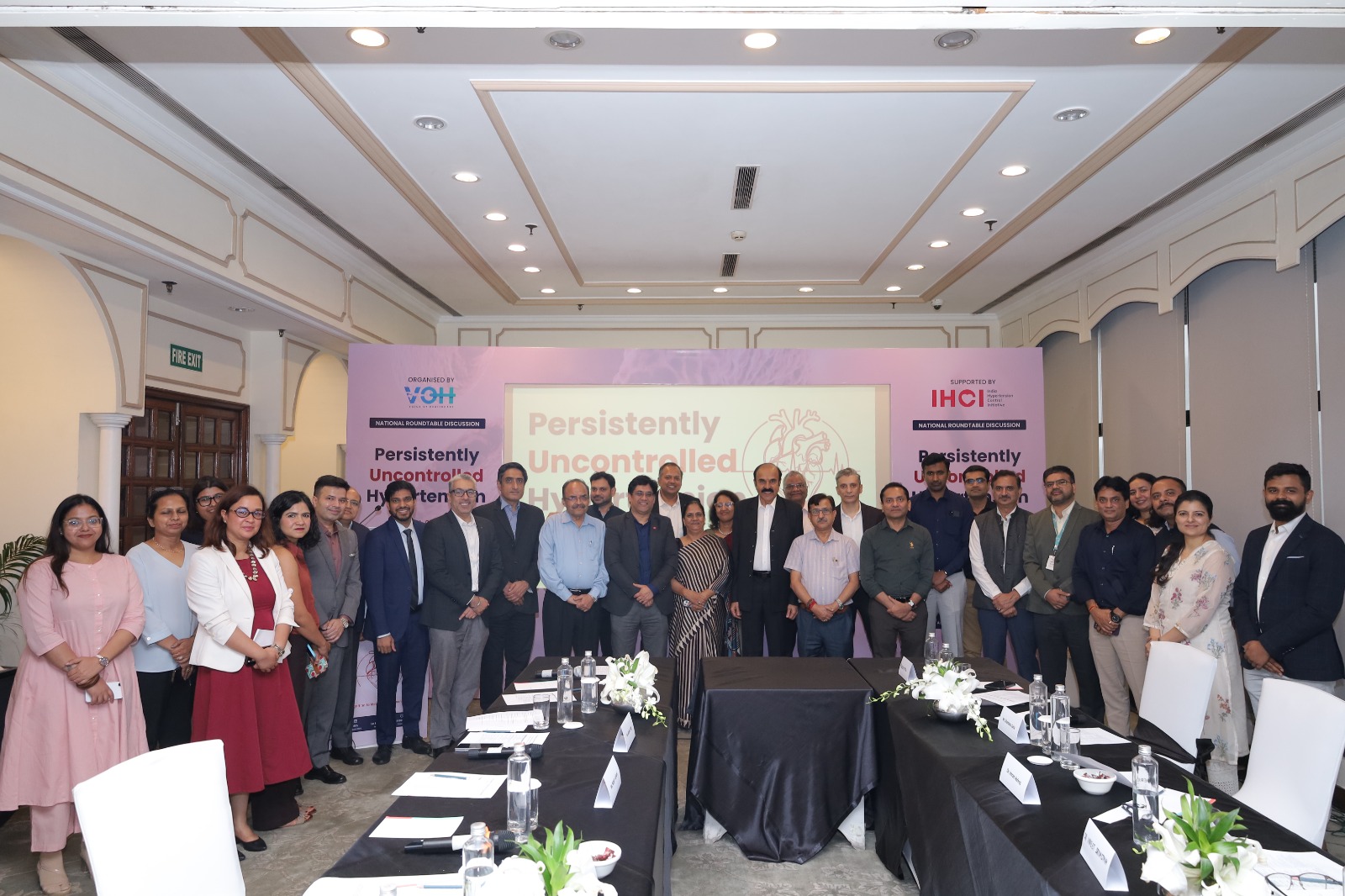
NEW DELHI, INDIA, 12 August 2026 – Voice of Healthcare (VOH) today announced the conclusion of its milestone national roundtable summit, bringing together leading national healthcare experts to address the critical public health challenge of persistently uncontrolled hypertension. The summit, titled “Persistently Uncontrolled Hypertension: From Recognition to Mechanism-Driven Care in India,” held at Le Méridien, New Delhi, established a scalable, evidence-informed framework for national hypertension care.
Hypertension remains a leading driver of chronic kidney disease (CKD), stroke, cardiovascular events, and premature mortality in India. As healthcare systems evolve, clinical experts and leading medical bodies are calling for a vital paradigm shift from a purely blood-pressurenumber-driven approach to personalized, mechanism-driven care to halt progressive organ damage.
The roundtable featured distinct keynotes and insight addresses from national scientific, digital health, and state administrative leaders, framing the scale of the challenge and establishing the policy directions for intervention.
The roundtable commenced with a context-setting session moderated by Dr. P. Ganeshkumar, Scientist E and Head, Division of Non-Communicable Diseases (NCDs), ICMR–National Institute of Epidemiology. Setting the tone for the discussions, Dr. Ganeshkumar highlighted the growing burden of persistently uncontrolled hypertension in India, noting that despite significant progress under the India Hypertension Control Initiative (IHCI), blood pressure control remains suboptimal. He emphasised that "It is time we move beyond merely identifying the problem. Our focus must now shift to mechanism-driven diagnosis, implementation research, and evidence-based interventions that can translate into better long-term outcomes for patients with persistently uncontrolled hypertension”.
Following up, offering a state-level perspective, Dr. Suman Singh, Director of Health Services and Managing Director, NHM Chandigarh, highlighted Chandigarh's progress in strengthening primary healthcare through universal enrolment under the National Programme for Prevention and Control of NCDs and routine blood pressure screening for all OPD patients. She also noted the rising incidence of hypertension among younger adults and shared Chandigarh's innovative 24×7 Geriatric Care mobile ambulance model, which delivers screening, treatment, and counselling to elderly and homebound patients. She concluded that, "Hypertension is no longer a disease of old age. We are increasingly seeing younger individuals presenting with uncontrolled blood pressure, making early screening and accessible community-based care more important than ever”.
Highlighting the role of digital health in improving hypertension care, Dr. Pankaj Arora, Director of Adoption, National Health Authority (NHA), showcased how the Ayushman Bharat Health Account (ABHA) and AI-enabled Clinical Decision Support Systems (CDSS) are strengthening clinical decision-making. He explained that the platform provides healthcare professionals with real-time, evidence-based treatment recommendations and safety alerts, enabling more personalized, accurate, and safer hypertension management across healthcare settings. "Digital health is no longer just about digitizing records—it is about enabling clinicians to make timely, evidence-based decisions that improve patient safety and longterm outcomes," said Dr. Pankaj Arora.
To provide a health systems perspective, Dr. Roopa Shivashankar, Scientist-F, Division of Delivery Research, ICMR Headquarters, highlighted that hypertension control in India remains low due to clinical inertia, treatment adherence challenges, and systemic barriers. She emphasized the need for patient-centric care models, including longer medication refill cycles for stable patients, and outlined ongoing ICMR research initiatives focused on strengthening primary care, community engagement, and digital implementation to improve hypertension outcomes. "Improving hypertension control requires addressing not only patient-related factors but also clinical inertia and health system gaps through evidence-based implementation research and patient-centric care models," said Dr. Roopa Shivashankar.
Dr. Vimal Mehta, Professor, Department of Cardiology, Maulana Azad Medical College, Govt. of NCT of Delhi, highlighted the need to shift the focus from managing established disease to preventing its progression. He emphasized that greater attention must be given to people with prediabetes and prehypertension, particularly younger populations, through early screening and preventive interventions. He concluded that, ‘’We are looking in the wrong direction if we focus only on treating diabetes and hypertension. The real opportunity lies in identifying prediabetes and prehypertension early and preventing their progression. We need to start screening younger populations and build prevention into the way we approach these growing health challenges’’.
The subsequent panel discussion, featuring Dr. Ashwani Gupta, Dr. Sanjeev Gulati, Dr. Sandeep Bansal, Dr. Vimal Mehta, Mr. Aseem Garg, Dr. Sandeep Arora, Dr. V. Prakash, Dr. K. Madan Gopal, Mr. Shantanu Saha, Ms. Nupur Lalvani, and Mr. Ram Khandelwal, explored the clinical, economic, and patient-centred dimensions of persistently uncontrolled hypertension.
The experts collectively emphasized the need for earlier identification of secondary hypertension, particularly primary aldosteronism, strengthened cardiorenal risk assessment, wider adoption of validated blood pressure measurement practices, evidence-based treatment pathways, and greater participation in India-specific clinical research.
The discussion also highlighted the importance of investing in preventive healthcare, improving referral systems, leveraging digital health solutions, and generating robust local evidence to support mechanism-driven hypertension management.
The panel further underscored that sustainable hypertension control requires active patient participation through improved health literacy, treatment adherence, routine health screening, supportive communities, and collaborative action between clinicians, policymakers, researchers, and patient advocacy groups to reduce the growing burden of cardiovascular and kidney diseases.
Distinguished Participants
The roundtable was attended by a distinguished group of experts, policymakers, clinicians, patient advocates, and industry leaders, including:
Dr. Suman Singh – Director, Health & Family Welfare, UT Chandigarh
Dr. Pankaj Arora – Director, Adoption, National Health Authority
Dr. Roopa Shivashankar – Scientist-F, Division of Delivery Research, ICMR Headquarters, New Delhi
Dr. P. Ganeshkumar – Scientist E & Head, Division of Noncommunicable Diseases, ICMR – National Institute of Epidemiology
Dr. Prakash Venkatesan – Deputy Director, National Health Mission, Chennai
Dr. K. Madan Gopal – Senior Health Sector Expert; Former Senior Consultant (Health), NITI Aayog
Dr. Ashwani Gupta – President, Indian Society of Nephrology; Co-Chairman, Department of Nephrology, Sir Ganga Ram Hospital, New Delhi
Dr. A. Muruganathan – Vice President, Indian Society of Hypertension; Director, Physician Research Foundation (PRF)
Dr. Praveen Aswal – Additional Director (RH), Department of Medical, Health & Family Welfare, Government of Rajasthan
Dr. Tina Rawal – Senior Research Scientist, Public Health Foundation of India (PHFI)
Dr. Abhishek Kunwar – National Professional Officer – Non-Communicable Diseases, World Health Organization Country Office for India
Dr. Sandeep Bansal – Professor & Head, Department of Cardiology, VMCC & Safdarjung Hospital, New Delhi
Dr. Vimal Mehta – Professor, Department of Cardiology, Maulana Azad Medical College, Government of NCT of Delhi
Dr. Sanjeev Gulati – Chairman, Nephrology and Kidney Transplant, Fortis Hospitals Group, New Delhi
Dr. Sandeep Arora – Country Medical Director, Medical Affairs, AstraZeneca India
Mr. Aseem Garg – Founder, DCDC Kidney Care Network
Dr. Ashish Srivastava – Associate Director & Country Lead, Monitoring, Evaluation and Research, Jhpiego India
Dr. Ajay Patle – Deputy Director – Health Systems, PATH
Dr. Vineet Srivastava – Senior Director, NCD Programs, Jhpiego India
Dr. Jatin Thakkar – Medical Officer – Integrated People-Centric NCD Service Delivery, WHO India
Mr. Shantanu Saha – Former Director – Public Policy, Kidney Warriors Foundation
Ms. Nupur Lalvani – Founder Director, Blue Circle Diabetes Foundation
Mr. Ram Khandelwal – Founder, Heart Health India Foundation
Dr. Imran Hafeez – Additional Professor of Interventional Cardiology, SKIMS, Srinagar; Cofounder, Save Heart Kashmir Initiative
Dr. Praveen Mittal – Director – Corporate Affairs, AstraZeneca India
This roundtable marks a significant and necessary step in VOH's commitment to elevating India's most pressing healthcare conversations. Voice of Healthcare will continue to facilitate evidence-based dialogue, policy advocacy, and public awareness on hypertension and non-communicable disease management across India.